

AI in maintenance is no longer a future topic; it’s already available in real-world applications.
This blog post presents typical use cases that are already implemented in SAP S/4HANA, SAP APM, SAP Service and Asset Manager, and SAP Business Network Asset Collaboration, as well as others that are currently being introduced.
| Use Case | SAP Component(s) | Benefit |
| AI-assisted maintenance order recommendations | SAP S/4HANA Asset Management | Fast, consistent work order proposals |
| Predictive maintenance | SAP APM | Early detection of failures |
| Health scores | SAP APM, eIoT | Condition assessment, objective comparability |
| Speech and image recognition | SAP Service and Asset Manager | Simplified notifications and feedback |
| Document analysis | SAP Business Network Asset Collaboration, SAP Document Management | Well-founded, context-based solutions |
AI-Assisted Maintenance Order Recommendations
An example of an embedded AI function in SAP S/4HANA is the AI-assisted maintenance order recommendations. It evaluates incoming notifications, technical objects, historical records, and comparable cases. It then autonomously proposes appropriate work orders or measures from directly within the order management workflow.
Machine learning methods can also be applied, learning from existing data, for example, from completed work orders, feedback, and time-series records.
In practice, this delivers the following benefits:
- Faster and more consistent planning of maintenance measures
- Reduction of planning errors or gaps
- Support for less experienced users through data-driven recommendations
Example: Intelligent Maintenance Order Proposal
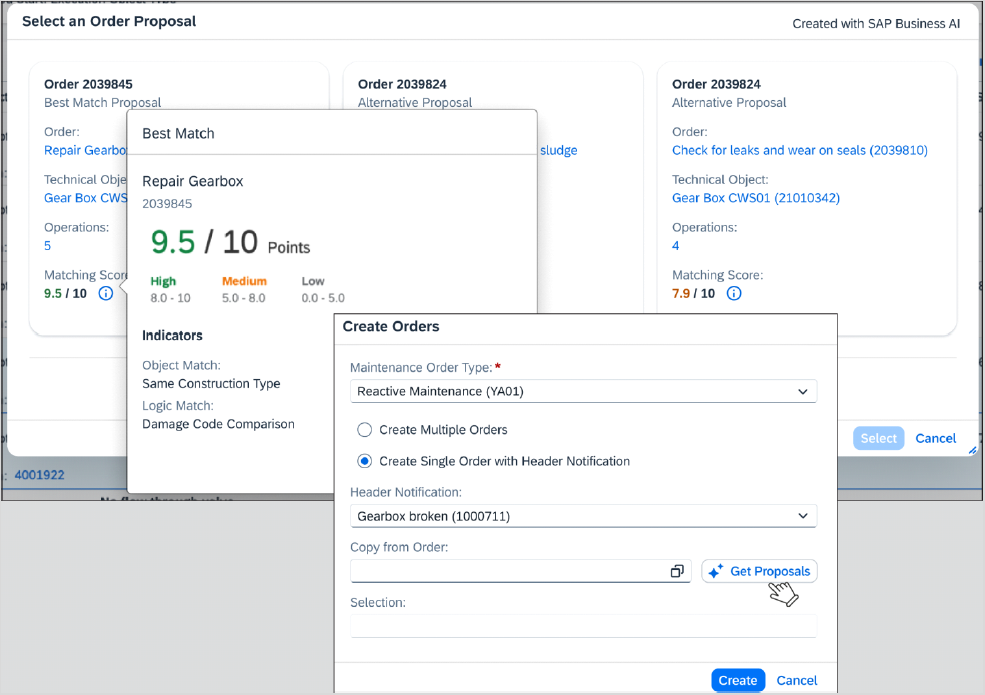
When a new free-text notification is entered, the system evaluates its phrasing, the associated equipment, and historical records. It identifies a high probability of a recurring fault and recommends a maintenance order with corresponding tasks and anticipated material requirements. Relevant information such as tasks, materials, services, and tools can be selected and transferred into the new order.
This figure demonstrates how the system analyzes a notification and generates an appropriate maintenance order proposal.
Prediction of Failure
In SAP APM, time-series data from sensors or feedback can be analyzed to identify upcoming failures, typically through anomaly detection or classification models.
Example: AI-Based Damage Prevention
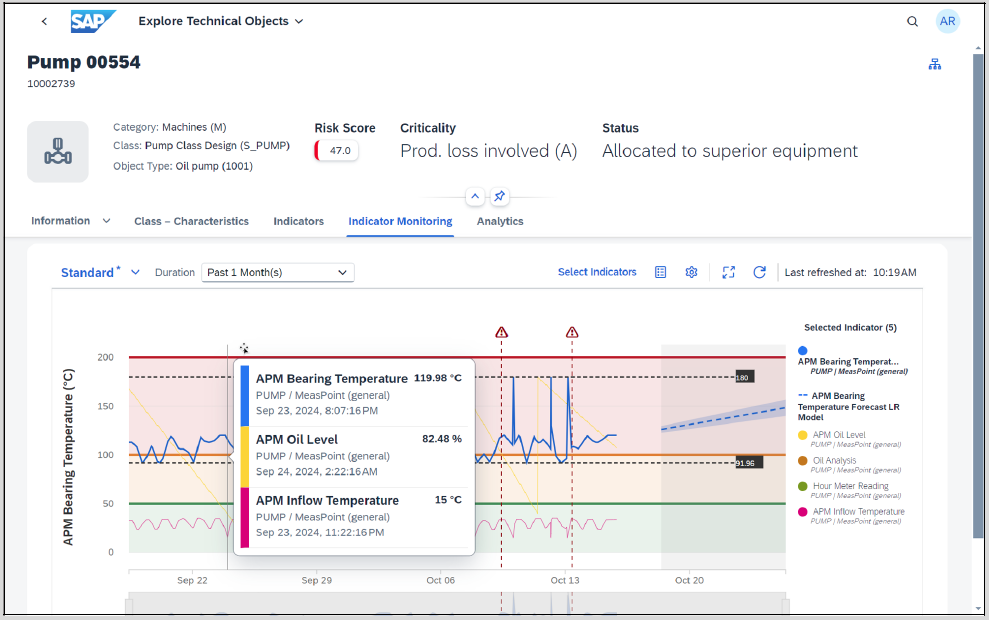
A pump bearing shows gradually increasing vibrations. AI identifies a typical pattern that has previously led to failure and issues an early warning before damage occurs. This figure illustrates anomaly detection in the time-series chart of SAP APM.
Condition Assessment and Health Scores
SAP APM provides health scores, a composite metric that consolidates the condition of an asset based on multiple indicators such as temperature, operating hours, vibration levels, or maintenance feedback. By combining these signals, the system creates a simplified condition indicator that helps maintenance planners quickly assess the overall status of technical objects. Health scores typically aggregate data from different sources, including measurement points, sensor streams, inspection results, and historical maintenance records.
The calculated score allows assets to be compared across large equipment fleets and helps identify critical objects that require attention.
Machine learning models can further enhance this assessment by analyzing historical patterns in time-series data. For example, correlations between vibration behavior, temperature changes, and operating duration may reveal early signs of degradation. These insights enable predictive maintenance strategies and support risk-based prioritization of maintenance activities.
Assistance in Spare Part Selection
Another practical application of AI in maintenance is the recommendation of suitable spare parts. When specific failures occur repeatedly, machine learning models can analyze historical maintenance records, material consumption, and repair feedback to identify typical repair patterns. Based on this analysis, the system can suggest spare parts that were frequently used to resolve similar issues in the past. These recommendations may appear during notification processing or work order planning, supporting maintenance planners in selecting appropriate materials more quickly.
Such recommendations are particularly valuable in large asset fleets where multiple technicians document repairs differently or where spare parts catalogs are extensive. AI-supported analysis can identify frequently used components, typical repair kits, or alternative materials that have proven effective in similar cases.
In practice, this functionality helps reduce planning effort, improve material availability during maintenance execution, and increase the consistency of repair procedures.
Voice Interaction and Image Processing
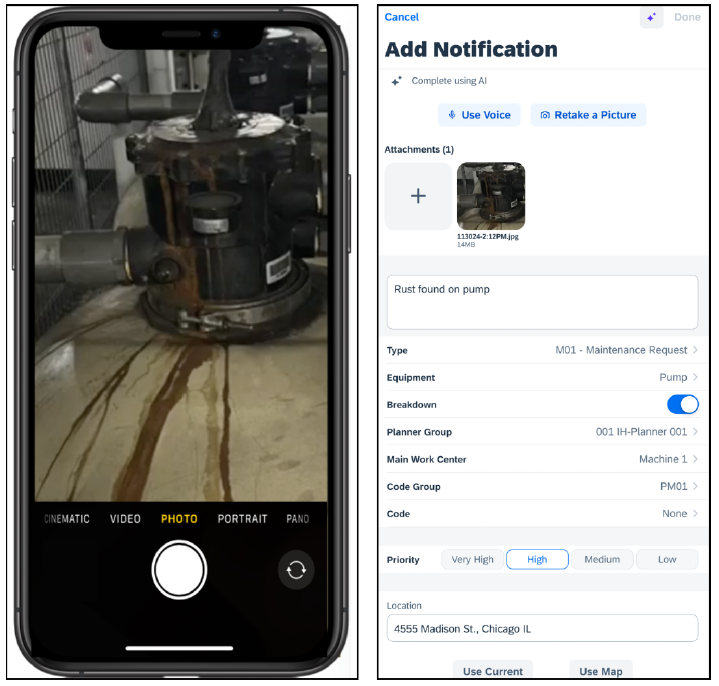
SAP Service and Asset Manager offers mobile functionality that enables users to dictate notifications, capture damage evidence with photos, and document inspections visually. AI provides assistance through:
- Speech-to-text conversion for reporting and feedback
- Identifying objects or damage signatures in captured images (see figure below)
- Automated image comparison to highlight changes (before/after)
Conclusion
AI in plant maintenance is already part of daily work in SAP. It proposes maintenance orders, suggests spare parts, and flags a failing pump bearing before it breaks. All of these use cases run on data that maintenance teams already collect, such as notifications, completed orders, sensor readings, and repair feedback, so their recommendations get better as that information builds up. For planners and technicians, that means faster decisions, fewer planning gaps, and more support for less experienced staff.
Editor’s note: This post has been adapted from a section of the book Plant Maintenance with SAP S/4HANA: Business User Guide by Karl Liebstückel and Markus Seidl. Prof. Dr. Liebstückel was a professor of information management and business software at the Technical University Würzburg-Schweinfurt in Germany, and he has approximately 40 years of experience in the field of enterprise asset management. Markus is a chief solution architect at SAP with more than 25 years of experience in the field of enterprise asset management.


Comments