
Every agent you build on SAP Business AI eventually has to call a large language model, and the generative AI hub is where that call gets routed, secured, and paid for.
In the agentic stack, if SAP Domain Models are the specialized business brain, then the generative AI hub is the central switchboard. It’s a single, secure gateway that connects all your SAP applications and agents to the wider world of LLMs.
For architects, the generative AI hub solves two huge headaches: fragmentation and fear. The AI market is moving at a dizzying pace; new models from OpenAI, Google, Anthropic, and Mistral pop up seemingly every week. Hardcoding an agent for a specific provider’s API is a strategic mistake as it creates vendor lock-in, complicates security, and makes it impossible to switch to a better or cheaper model when one comes along.
This figure provides details about the generative AI hub, which is utilized as an AI-powered extension. We’ll discuss the components involved in the generative AI hub in detail from an SAP context.
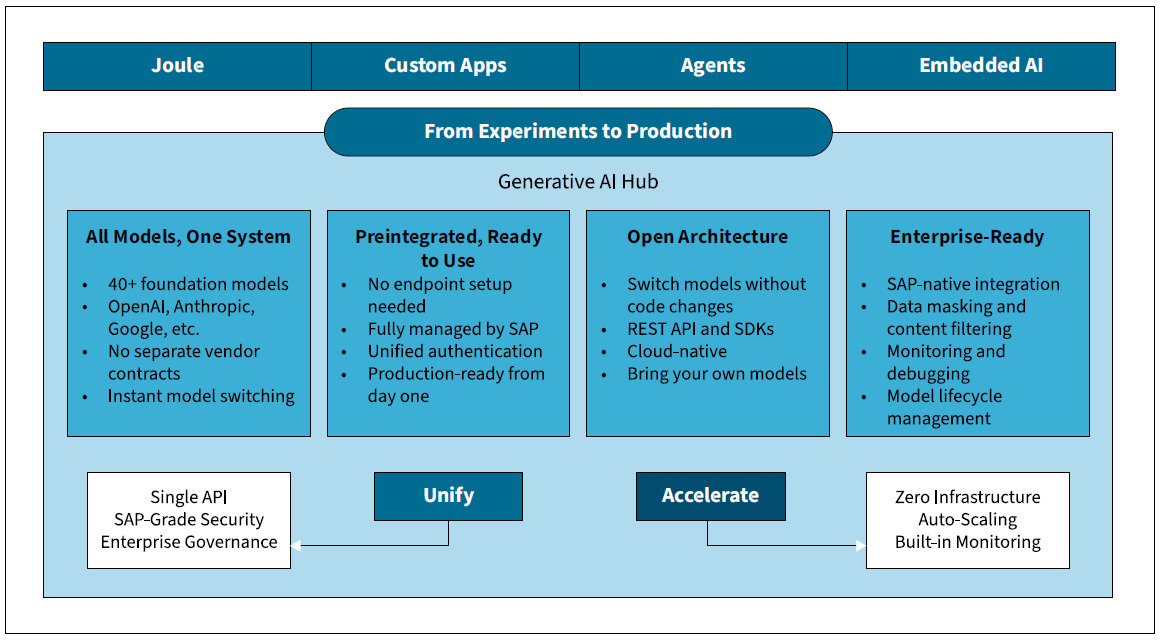
The generative AI hub acts as an abstraction layer, sitting between your applications and the raw model providers. It gives you three critical things: model orchestration, enterprise-grade security, and a solid developer workflow.
Now let’s dive a bit deeper into the various aspects of the generative AI hub.
The Multimodel Strategy: The Model Router
The core idea of the hub is to give you access without locking you in. It provides instant, managed access to a curated list of the world’s best models, covering a huge portion of the market. Instead of juggling separate contracts, API keys, and billing with Azure OpenAI, Google Vertex AI, and AWS Bedrock, you manage a single connection to the generative AI hub. The hub creates a unified API through SAP AI Core that standardizes how you talk to any model.
It’s best to follow a philosophy of choosing the right model for the right task: In an agent-based world, you don’t need a sledgehammer for every nut. The hub lets you use a tiered strategy:
- The Heavy Lifters (Reasoning and Planning): For really complex jobs such as analyzing a supply chain disruption or writing ABAP code, agents can call on high-IQ models such as GPT-4o or Gemini 1.5 Pro. These have the massive context windows and logical power needed for the reasoning phase of the agent loop.
- The Speed Demons (Classification and Summarization): For simpler tasks such as figuring out if an email is a complaint or an inquiry or just summarizing meeting notes, agents can be routed to faster, cheaper models such as GPT-4o mini, Claude 3 Haiku, or Gemini 1.5 Flash.
- The Sovereign Options: For European customers, public-sector entities, or government agencies with strict data residency rules, the hub offers models such as Mistral Large, which can be deployed with tighter regional controls.
The architectural benefit here is huge as this abstraction allows for hot swapping. If a new model comes out that’s 50 percent cheaper and 20 percent faster, the Center of Excellence (CoE) can simply update the agent’s configuration in the hub to point to the new model, all without touching a single line of the agent’s code.
The Security Shield (Zero Data Retention)
The biggest barrier to adopting AI like this is the fear of data leaks. Chief information officers are right to worry that their company’s private data, sent to an LLM, might be stored or used to train the provider’s next model. The generative AI hub is designed to eliminate this risk with a proxy architecture backed by strict legal and technical safeguards and rock-solid contractual guarantees:
- Zero Data Retention Policy: SAP has specific enterprise agreements with hyperscalers like Microsoft, Google, and Amazon. When your agent sends a prompt through the hub, the provider is contractually and technically forbidden from storing your data or using it for training. Your data only exists in the model’s memory for the milliseconds it takes to generate a response, and then it is discarded.
- The Proxy Data Flow: When an agent needs enterprise data held behind the firewall, it does not connect to the source directly. The request travels through a secure proxy, the cloud connector and destination layer; this authenticates the call, enforces the acting user’s authorizations, and returns only permitted data. The flow works as follows:
- Request: The agent sends a prompt to the hub.
- Sanitization: The hub (via the AI trust layer) scans the prompt for PII and applies masking (e.g., replacing John Doe with PERSON_1).
- Transmission: The masked prompt is sent to the model provider (e.g., Azure OpenAI) via an encrypted tunnel.
- Generation: The model generates the response using the masked data.
- Rehydration: The hub receives the response, unmasks the data (restoring John Doe), and returns it to the agent.
This architecture ensures that the raw model provider never sees the unmasked PII, and the customer retains full sovereignty over their data lineage. Basically, the process ensures the model provider never gets access to your sensitive data, and you maintain complete control over your data’s journey.
The Developer Workbench: From Playground to Production
Building agents takes more than an API call; it takes a proper workflow. The generative AI hub includes tools to streamline the whole build-test-deploy cycle for your developers and prompt engineers. Let’s look at what it takes for that to happen:
- The Playground: In a graphical user interface (GUI), developers can experiment with and test different models side by side. They can try prompts against GPT-4, Gemini, and many other models simultaneously to compare latency, accuracy, and cost before making a choice.
- Prompt Management: In agentic AI, a prompt is effectively code. It defines the agent’s persona, constraints, rules, and logic. The hub includes a prompt registry that allows teams to treat prompts as software assets. These prompts can be versioned, tagged, and managed centrally. This separates the prompt from the application code, which means, for example, that a business analyst can tweak an agent’s tone of voice in the registry without needing a developer to redeploy the whole app.
- SDK Integration (SAP Cloud Application Programming Model and Python): For pro-code development, the hub is fully integrated into the SAP Cloud Application Programming Model and offers a Python software development kit (SDK), letting developers use standard paradigms while authenticating securely against SAP Business AI Platform.
Operational Governance: The Meter
Agents can get expensive very fast. An agent that gets stuck in a loop could burn through thousands of tokens a minute. The generative AI hub acts as the central metering point for the whole enterprise. It provides detailed telemetry on token consumption, broken down by cost center or application. This lets the AI CoE set up chargeback models so that departments using AI (like HR or finance) pay for the resources their agents consume. It also lets you set rate limits to prevent a runaway agent from blowing your entire monthly AI budget in an afternoon.
Conclusion
When your team plans its first production agent, start with the hub instead of a specific model provider. Decide early which tasks deserve a heavy reasoning model and which can run on something faster and cheaper, move your prompts into the registry before they get buried in application code, and settle rate limits and chargeback rules with finance while the agent count is still small. Those decisions take an afternoon now and a painful quarter to retrofit later. Then, when a better or cheaper model comes out next month, switching to it becomes a configuration change.
Editor’s note: This post has been adapted from a section of the e-book Agentic AI with SAP by Raghu Banda and Shibaji Chandra. Raghu is an enterprise AI strategist and technology leader at SAP with more than 25 years of SAP experience and nearly three decades across enterprise technology, architecture, product innovation, and digital transformation. Shibaji is a visionary AI leader and principal enterprise architect at SAP with more than 23 years of experience driving enterprise-scale AI transformation.
This post was originally published 10/2026.




Comments