

Modern enterprise efficiency is defined by the speed of data-driven action. Seven core technologies make up the SAP Business AI architecture. Combined, they form a closed-loop system that allows the enterprise to see, think, act, and learn alongside its human counterparts.
Let’s walk through each:
Generative AI and Joule
Generative AI serves as both the primary interface and the orchestration backbone of the Autonomous Enterprise. Centered on Joule, SAP’s natural language engagement layer, it uses large language models (LLMs) to synthesize information, generate content, interpret intent, and coordinate action. Joule balances probabilistic reasoning (LLMs for interpretation, summarization, and recommendation) with deterministic execution (structured APIs, business rules, and transactional logic). As an interface, it eliminates navigation debt. As an orchestrator, it routes user intent to the appropriate assistants and agents. This is the hierarchy in practice: People direct through Joule, assistants orchestrate, and agents execute.
This figure shows Joule as the engagement layer of the Autonomous Enterprise, illustrating how the AI assistant serves as the unified interface through which users set intent and the system executes across all applications.
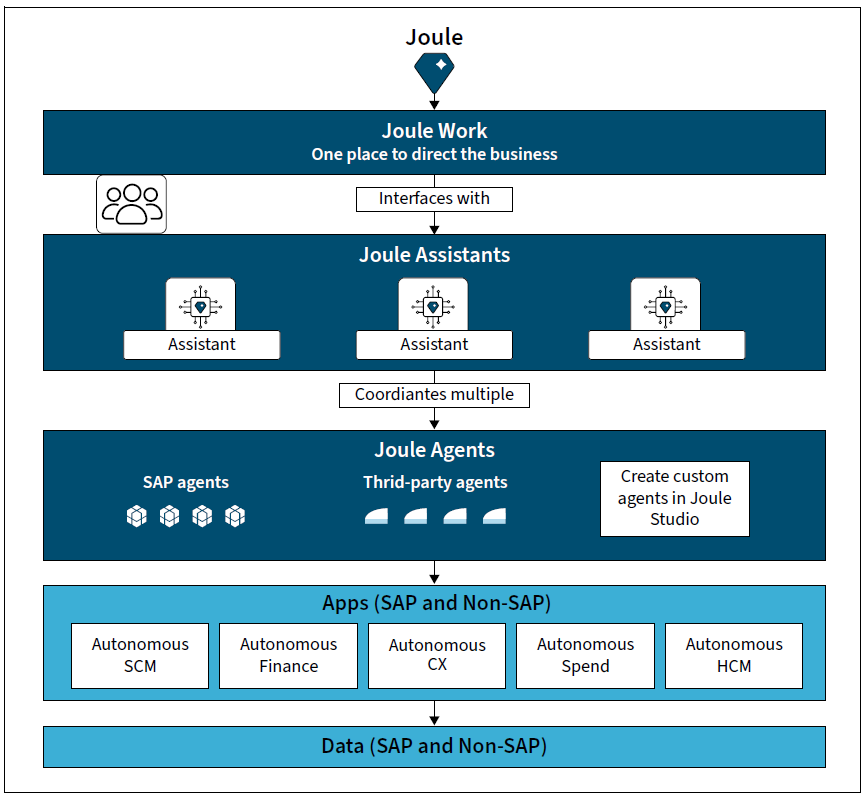
In practice, Joule operates across a spectrum from simple retrieval to full autonomous execution. At the simpler end, users ask questions grounded in live business data. At the transactional level, Joule executes operations through natural language commands that replace multiscreen workflows. At the analytical level, it synthesizes cross-functional data into visualizations and recommendations. Finally, at the agentic level, it accepts a high-level goal, decomposes it into a plan, activates agents, and returns the completed outcome.
Agentic AI and Assistants
This layer moves beyond conversation and into orchestration, transitioning the system from reactive helper to proactive partner. Joule Assistants are role-aware persona hubs, and Joule Agents are specialized digital workers that handle complex, multistep workflows using reasoning and autonomous planning.
Process Automation
This technology provides the physical execution capability. By combining robotic process automation with workflow management and AI services for processing unstructured documents, it automates the “last mile” of business processes. In the Autonomous Enterprise, process automation provides the “hands” that agents use to act on their decisions: releasing payments, creating purchase orders, updating production schedules, and so on.
Predictive Analytics and Machine Learning
Whereas generative AI addresses what is, predictive analytics addresses what will be. This layer uses statistical algorithms, ML models, and proprietary foundation models such as SAP-RPT-1 to identify patterns in historical data. From demand sensing in the supply chain to predicting employee attrition in HR, these tools provide the confidence levels required for high-stakes planning.
Situation Handling
The system’s early warning framework continuously monitors business objects for exceptions or critical events. By 2026, this technology became AI-assisted. It notifies users of problems, but it also analyzes context and recommends the next best action to resolve a problem.
SAP Knowledge Graph
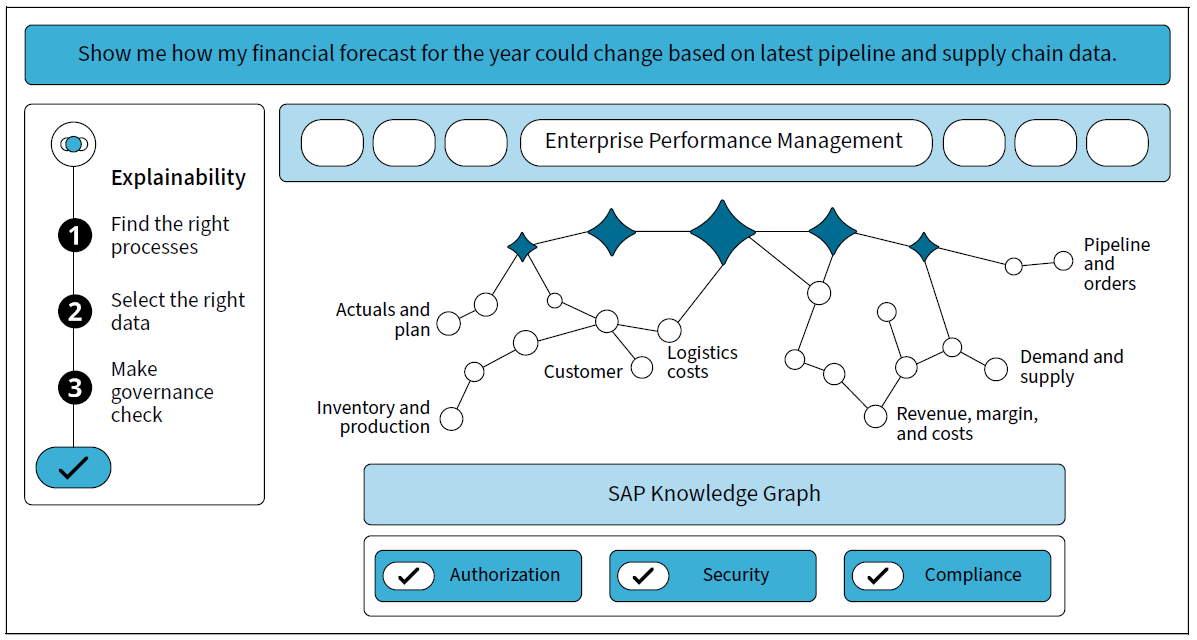
SAP Knowledge Graph maps complex relationships between business objects, encodes 50 years of process knowledge, and provides semantic context that allows agents to reason about business situations rather than merely process data. When a disruption hits a supply region, SAP Knowledge Graph shows affected suppliers, at-risk orders, dependent schedules, and alternative sources.
This figure illustrates how complex relationships between business objects are mapped and encoded in SAP Knowledge Graph to provide AI with a deep, contextual understanding of enterprise processes.
Embodied Intelligence
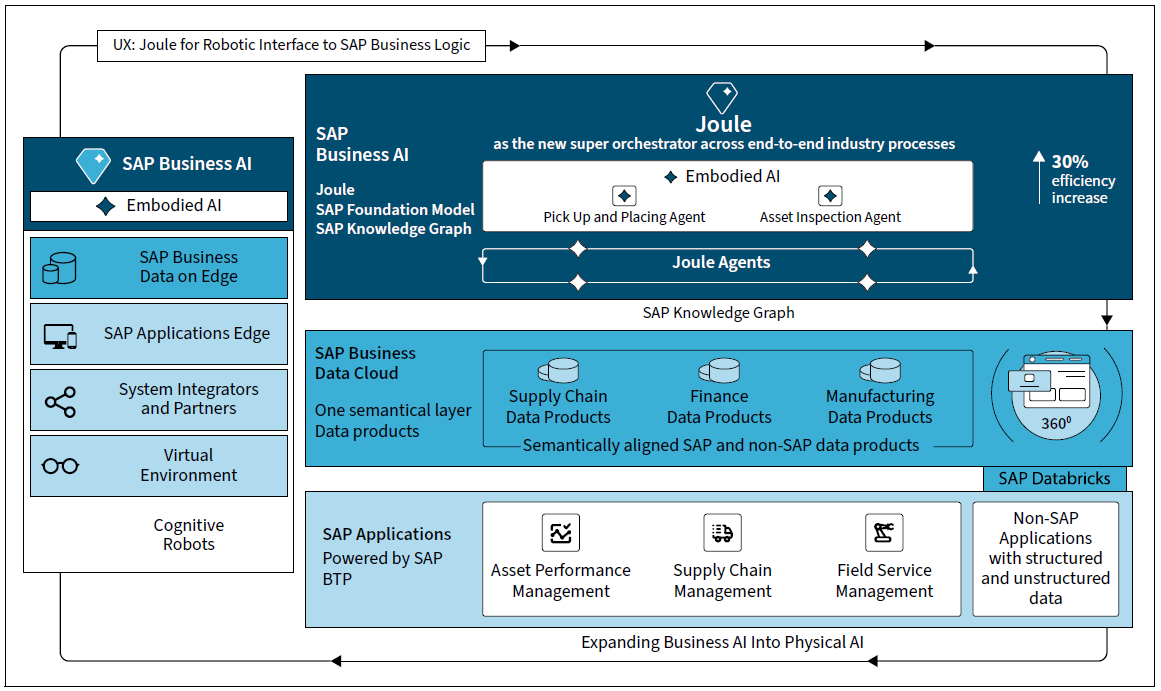
This technology integrates reasoning into robotic hardware, extending AI from digital processes into physical operations. Autonomous mobile robots in warehouses and robotic assembly on shop floors are all guided by SAP logistics intelligence and coordinated through Joule.
This figure shows the integration of embodied AI into SAP Autonomous Suite, illustrating how AI reasoning is extended into robotic hardware and physical operations connected to digital business processes.
Together, these seven technologies form the SAP intelligent stack. The table below maps each one to its primary role in the architecture and the business value it delivers when embedded inside enterprise processes.
| Intelligent Technology | Primary Role | Business Value |
| Generative AI | Communication and synthesis | Reduces time to insight via natural language |
| Agentic AI | Goal-oriented execution | Autonomously completes complex, multistep tasks |
| Predictive analytics | Pattern recognition | Shifts the enterprise from reactive to proactive |
| Situation handling | Exception management | Ensures no critical business event goes untouched |
| Process automation | Task execution | Eliminated manual data entry and "swivel chair" work |
| SAP Knowledge Graph | Semantic context and grounding | Eliminates AI hallucinations and provides connected construct by making explicit relationships between all SAP and non-SAP datasets |
| Embodied Intelligence | Physical cognition and execution | Automates complex physical tasks by bridging digital intent with autonomous real-world action |
Editor’s note: This post has been adapted from a section of the book The Autonomous Enterprise with SAP: Apps, Data, and AI in Action by Nitin Singh, Jason Porterfield, Srinivas Devarapalli, Joffy Mathew, Cooper Walsh, and Lyssa Aruda. Nitin is a managing principal for architecture advisory at SAP America, helping Fortune 500 companies translate strategy into transformation outcomes. Jason leads SAP America’s Americas Architecture Advisory practice, guiding strategic enterprise transformations across the region. Srini is an AI GTM strategy and advisory lead guiding enterprises on adopting SAP Business AI with a clear strategy, value roadmap, and responsible agentic and embedded AI capabilities. Joffy is a senior director in SAP BDC product management. He has 28 years of global SAP experience and is a seasoned strategist and results-oriented professional with demonstrated success leading high-profile, complex initiatives to develop strategy and delivery of enterprise data management and analytics solutions. Cooper is a senior solution advisor for SAP BTP. He has worked at SAP for 10 years, focusing exclusively on SAP BTP. Lyssa is a senior solution advisor at SAP with more than a decade of experience leading large-scale enterprise transformations.




Comments