

SAP Snowflake extends SAP Business Data Cloud with Snowflake-based data engineering, analytics, AI, and interoperability capabilities as part of SAP’s broader open data ecosystem strategy.
SAP Snowflake is positioned as a solution extension for SAP Business Data Cloud. In this model, Snowflake capabilities are provisioned, sold, billed, and supported through SAP while remaining aligned with native Snowflake platform services and capabilities.
SAP Snowflake provides flexible compute and storage capabilities that complement the broader SAP Business Data Cloud architecture. Organizations can use Snowflake capabilities together with SAP-managed data products, intelligent applications, SAP Datasphere, and SAP BW modernization scenarios.
This figure illustrates SAP Snowflake participating within the SAP Business Data Cloud architecture through interoperable data products, analytics and AI workloads, and integration across external analytical platforms.
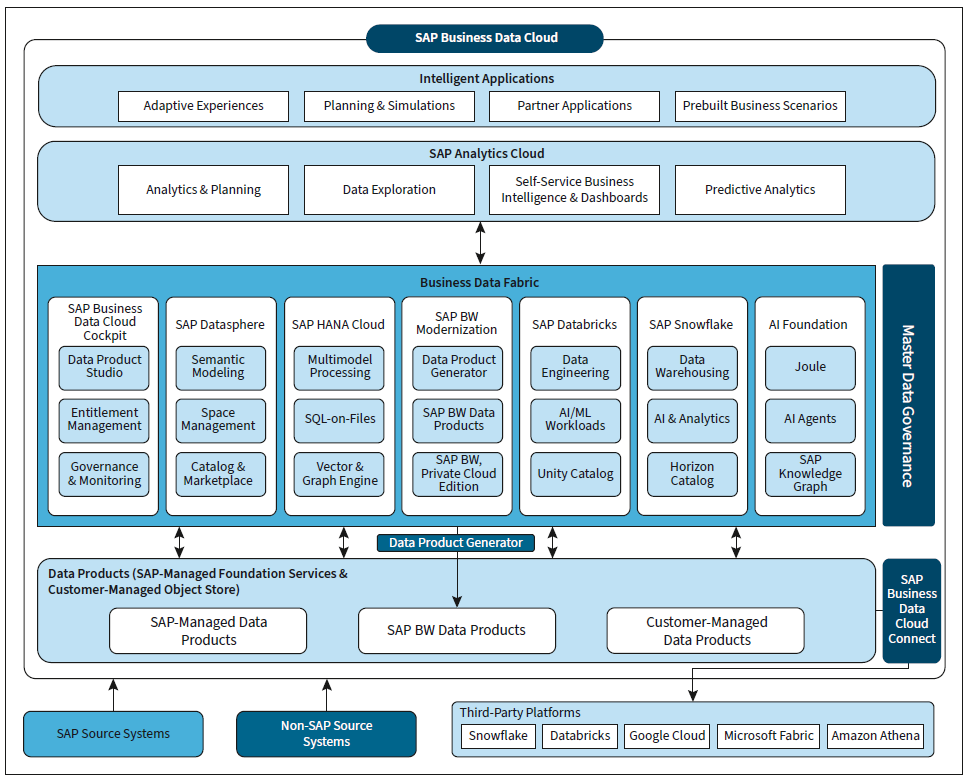
The platform supports multiple workload categories, including data engineering, large-scale analytics, AI and machine learning, and application development and collaboration. It also supports structured, semistructured, and unstructured data processing within a unified environment.
The next figure illustrates the high-level architectural capabilities of SAP Snowflake, including integrated workload support, governance services, interoperable storage structures, and cross-cloud processing capabilities.
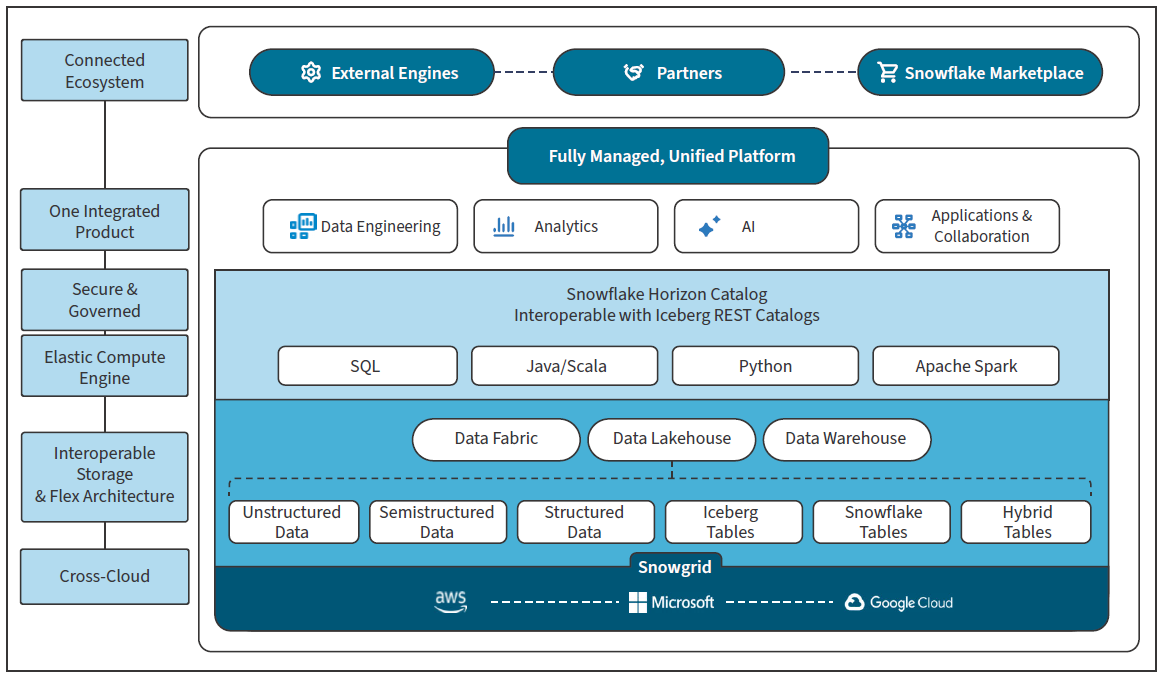
SAP Snowflake integrates with Snowflake ecosystem capabilities such as Snowflake Marketplace, Horizon Catalog, cross-cloud interoperability, and external processing engines. This enables organizations to combine SAP and non-SAP data across broader enterprise and partner ecosystems while maintaining governance and integration across platforms.
Within SAP Business Data Cloud, SAP-managed and customer-managed data products can be made available to SAP Snowflake environments through controlled interoperability and zero-copy sharing patterns, depending on the supported integration scenario. This allows organizations to consume semantically rich SAP data products directly within Snowflake without building complex extraction pipelines or duplicating large datasets.
SAP also positions SAP Snowflake as an important capability for SAP BW modernization. SAP BW data products generated within SAP Business Data Cloud can be consumed directly within SAP Snowflake environments for advanced analytics, AI/ML processing, and modern data engineering scenarios.
Architecturally, SAP Snowflake operates as a solution extension within the SAP Business Data Cloud ecosystem rather than as a first-party runtime component. This distinguishes it from SAP Databricks, which is a first-party service integral to SAP Business Data Cloud and consumable through SAP Business Data Cloud capacity units. This approach aligns with SAP’s broader business data fabric and open data ecosystem strategy.
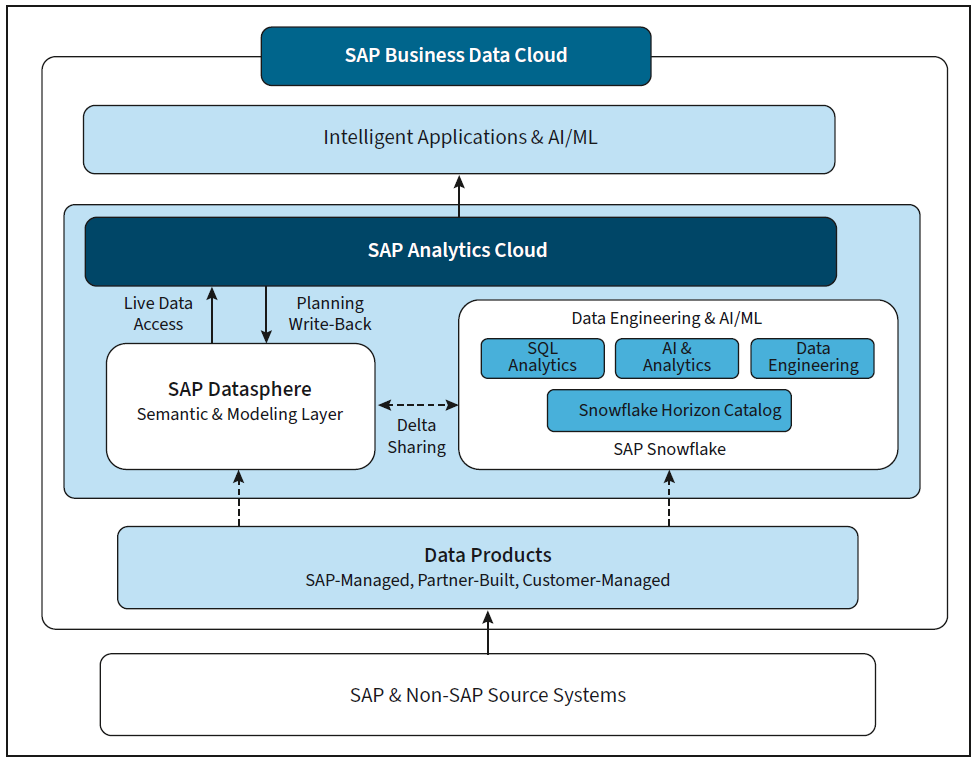
This figure illustrates the interoperability architecture between SAP Snowflake and SAP Business Data Cloud, including governed data product sharing, analytics and AI/ML workloads, semantic integration scenarios, and open ecosystem interoperability.
Conclusion
SAP Snowflake gives organizations that already rely on Snowflake a way to bring it into SAP Business Data Cloud, with purchasing, billing, and support all running through SAP. When choosing between it and SAP Databricks, the deciding factor is often practical: which platform your data teams already know, and where your existing workloads live. Because supported integration scenarios vary, check which ones apply to your SAP BW modernization and analytics plans before you commit.
Editor’s note: This post has been adapted from a section of the book SAP Business Data Cloud: An Introduction by Geetha Madhuri Bobbili. Geetha is an SAP data and analytics leader and associate director at Deloitte South Asia, with more than 12 years of experience helping global enterprises modernize their data and analytics ecosystems and enable data-driven decision-making.




Comments