

Most of the large and multinational organizations run SAP, and more than 70% of the world’s transactions happen in SAP.
Many of these organizations running SAP have their plants or operations across several countries and execute intercompany transactions. SAP supports intercompany processing for both variants from the very early days of SAP R/3.
In the following sections, we’ll compare the classic intercompany processing to the new advanced intercompany capabilities in SAP S/4HANA.
Classic Intercompany in SAP ERP
SAP’s intercompany solutions in SAP R/3, SAP ERP, and SAP S/4HANA (until the 2022 on premise/private cloud release) are typically referred to as classic intercompany solutions. SAP released an advanced version of the intercompany solution in SAP S/4HANA 2022 and SAP S/4HANA Cloud 2022 Private Edition. In the following sections, we’ll cover classic intercompany sales, classic intercompany stock transfer, and the limitations of both.
Classic Intercompany Sales
Classic intercompany sales delivers the goods directly to the customer from the delivering plant. A typical process flow is shown in this figure.
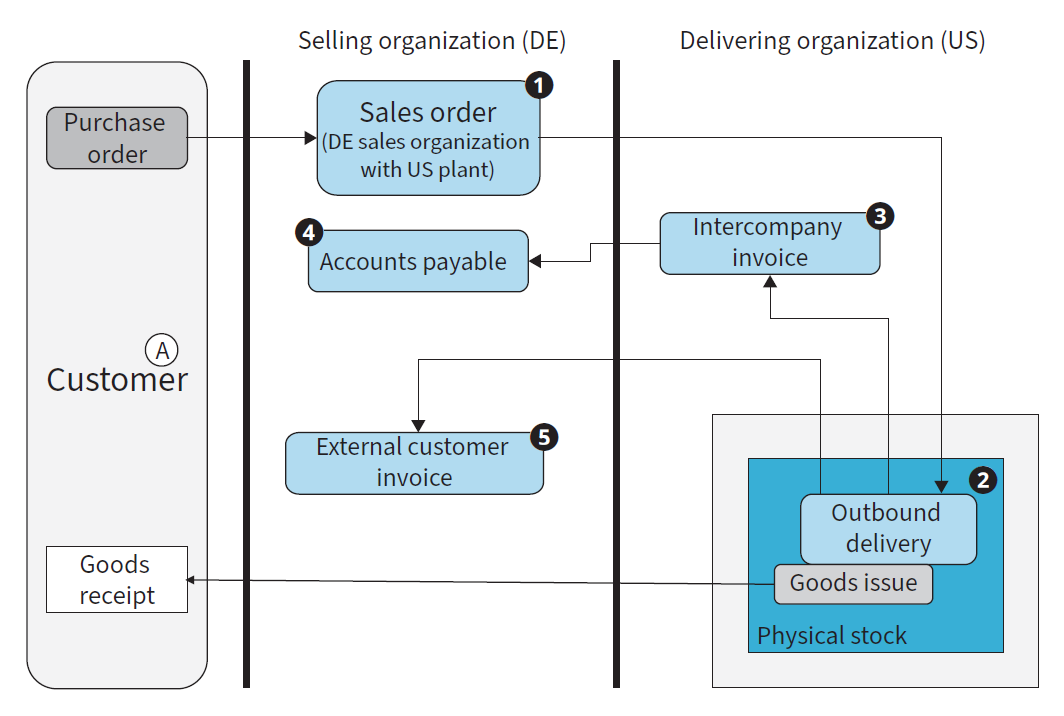
- Selling organization DE creates a sales order (sales document type OR [Standard Order]) for customer A with sales organization DE of selling organization DE and delivering plant US of delivering organization US. The assignment of delivering plant US in the sales order of selling organization DE of a different company code (DE) makes it an intercompany sales order (a standard sales order has the sales organization and delivering plant of the same country or company). The sales order has price condition type PR00 (Price) for external customer A and PI01 (Intercompany Price) or PI02 (Intercompany %) for intercompany billing.
- Delivering organization US creates an outbound delivery (delivery type LF, Delivery) with external customer A as the ship-to party. Goods are picked and packed, and subsequently post goods issue (PGI) is executed. Goods are shipped directly to the external customer. Goods don’t enter the premises of the selling organization, so there’s no valuated stock posting in the selling organization even though they are selling the goods to their German customer.
- Selling organization DE creates the customer invoice (billing type F2, Invoice) with a price corresponding to condition type PR00 (Price; as determined from the sales order). The intercompany invoice needs to be created first, and then the customer invoice can be created.
- Delivering organization US creates an intercompany invoice (billing type IV, Intercompany Billing) with a price in condition type IV01 (Intercompany Price) or IV02 (Intercompany%) determined from price condition type PI01 or PI02 of the sales order. The intercompany billing document has pricing procedure ICAA01 (Intercompany Billing), which is different from a regular pricing procedure such as RVAA01 (Standard).
- The accounts payable document is created in selling organization DE through an IDoc from the output of the intercompany billing document.
Classic Intercompany Stock Transfer
Stock transfer is the process of moving goods from one location to another location, such as a plant or a storage location. If the goods are moved between plants of the same company code, then it’s an intracompany stock transfer. If the goods are moved between plants of different company codes, then it’s an intercompany stock transfer, which we refer to as the classic intercompany stock transfer in SAP. A typical process flow for classic intercompany stock transfer is shown in this figure.
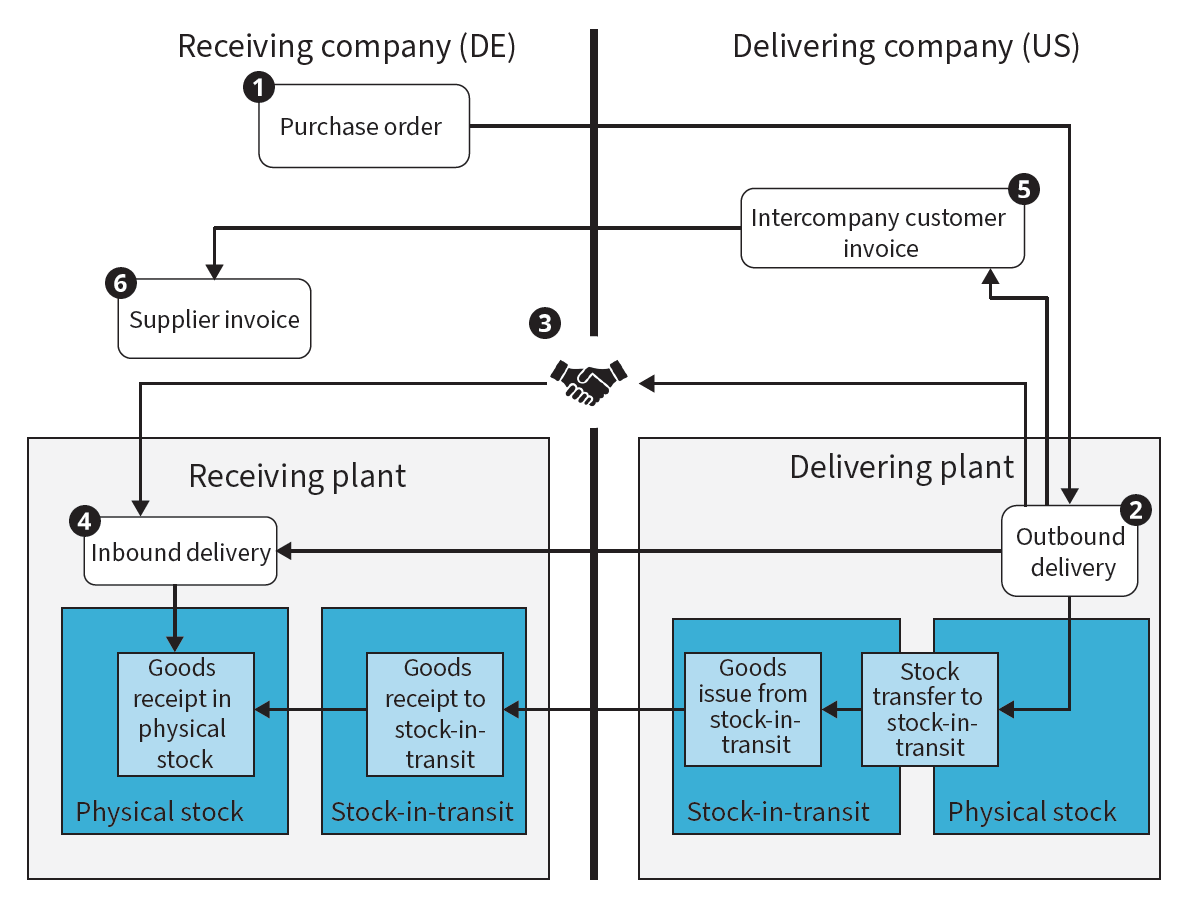
- The receiving company places a purchase order (document type NB, Standard PO; item category blank, standard) for the material with a vendor representing the delivering plant (belonging to the delivering company code). The receiving company generally starts this procurement based on some forecast for sales or production of another product.
- The delivering organization creates an outbound delivery (delivery type NLCC, Replen.Cross-Company) with reference to the purchase order 1 as a replenishment to the receiving plant. Goods are picked and packed, and subsequently, PGI is executed. The price of goods is the price agreed between the delivering and receiving organization (i.e., not the valuation price in the material master of the delivering plant). Goods are now in cross-company code stock-in-transit (i.e., not yet posted to the inventory of the receiving plant).
- Proof of delivery (PoD) transfers the ownership of goods from the delivering organization to the receiving organization. Goods are now transferred from goods issue from stock-in-transit to goods receipt to stock-in-transit of the receiving organization.
- Inbound delivery (delivery type EL, Inbound Delivery) is created in the receiving plant subsequent to PoD. Goods are now posted to the physical stock of the receiving plant, resulting in an increase in unrestricted stock in its inventory. Goods are valuated at the unit price of the purchase order (considering that the goods receipt happens before the invoice receipt).
- The intercompany customer invoice (billing type IV, Intercompany Billing) is created in the delivering company with reference to the outbound delivery with the intercompany price from the purchase order. The receiving company is the payer of the invoice.
- The supplier invoice (document type RE, Invoice - Gross) is created in the receiving company from an output of the intercompany customer invoice.
Note: Selling and delivering companies have been used as DE and US, respectively, just to explain intercompany processing. These can be any organizations operating between different countries (or company codes) within the same corporate group.
Limitations of Classic Intercompany Processes
Classic intercompany solutions have existed in SAP ERP for more than 30 years; however, they have several limitations from both the logistics and finance perspectives for intercompany processes in SAP. Limitations for the classic intercompany sales are highlighted in this figure.
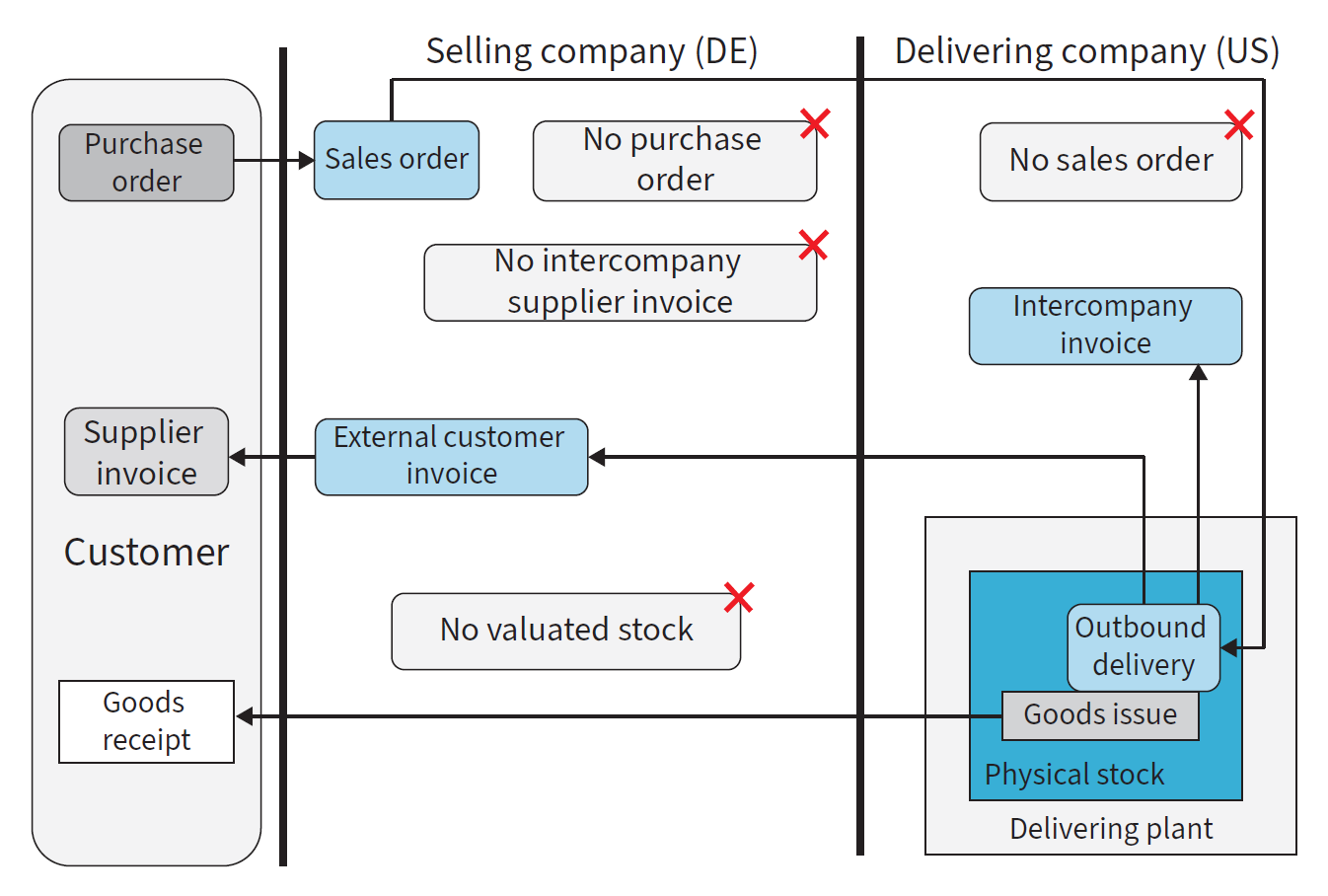
Let’s explore the major limitations:
- The selling company procures the goods from the delivering company, but the selling company doesn’t create and send a purchase order to the delivering company.
- The delivering company delivers goods, but there’s no sales order at their sales organization. The absence of a sales order is one of the major objections by the auditors.
- There’s no supplier invoice at the selling company for the supplied material (only an accounting document is generated through the IDoc output from the intercompany invoice) because there’s no purchase order.
- There’s no valuated stock posting at the selling company as the goods are shipped directly to the customer. As a result, there’s also no proper product costing or landed cost at the selling company.
- The delivering company is the cost carrier (or cost object), although the actual sale is happening through the selling organization.
- Period-end closing (results analysis, settlement) can be carried out only at the delivering company.
- The intercompany invoice requires a complex pricing mechanism with different pricing procedure and intercompany pricing condition types.
- There’s a fixed sequence for invoicing (first external customer invoice and then intercompany invoice).
- Event-based revenue recognition (EBRR) with the International Financial Reporting Standards (IFRS) accounting principle isn’t supported.
- Universal parallel accounting isn’t supported.
- Using more than two entities isn’t supported.
- There’s no tool to orchestrate or automate the processes.
Next, limitations for the classic intercompany stock transfer are highlighted here.
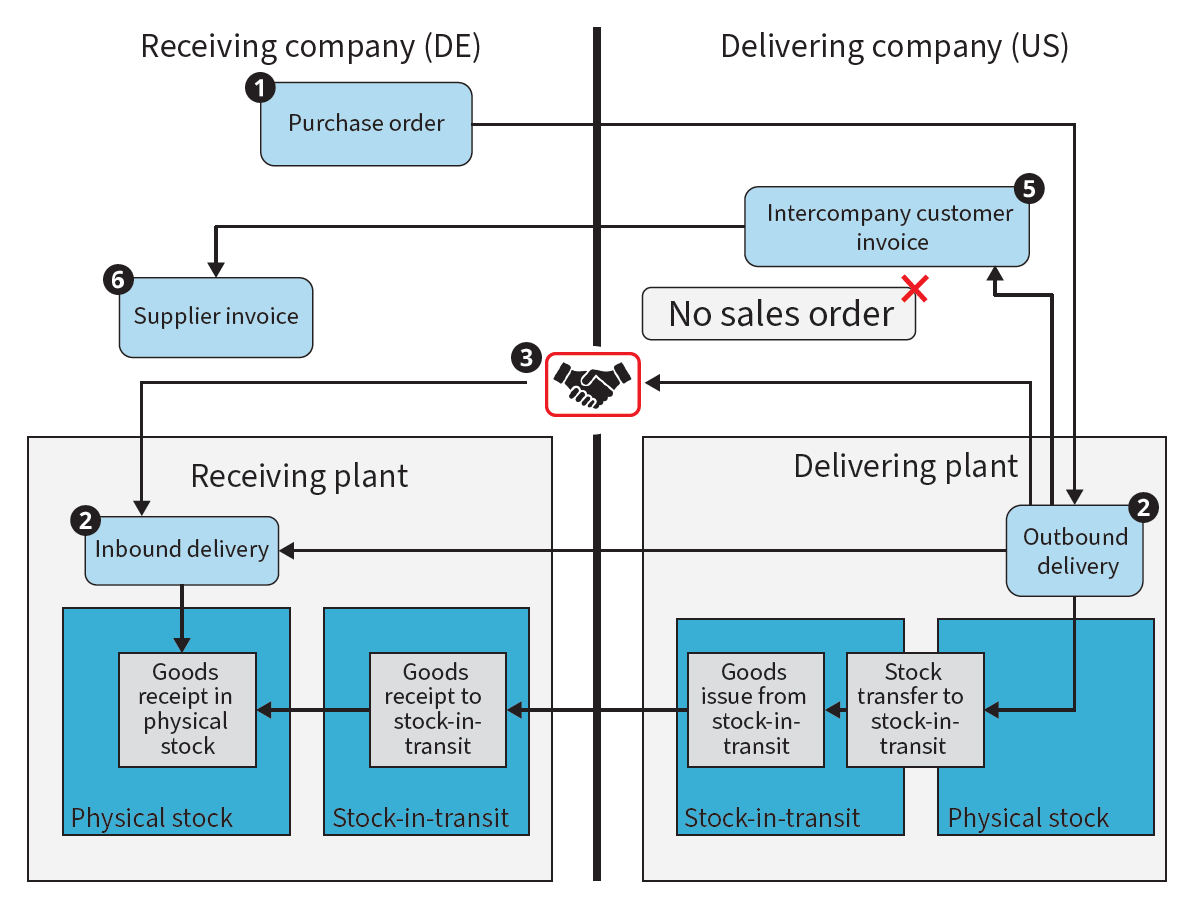
Let’s explore the major limitations of classic intercompany stock transfer:
- There’s no sales order in the delivering company, which is also a major objection brought up by auditors.
- No sales order–based key performance indicator (KPI) reporting is possible in the delivering organization.
- PoD is used as a handshake for the transfer of ownership from the delivering company to the receiving company. The PoD process is a bit cumbersome. If PoD is mandatory, then the invoice can’t be created unless PoD on delivery is done, which delays the billing cycle and revenue recognition.
- Using more than two entities isn’t supported.
- There’s no tool to orchestrate or automate the processes.
Advanced Intercompany Processes in SAP S/4HANA
SAP has provided a new intercompany solution, advanced intercompany sales and advanced intercompany stock transfer, with the 2022 release of on-premise SAP S/4HANA and SAP S/4HANA Cloud Private Edition to eliminate the limitations of classic intercompany sales and classic intercompany stock transfer. This advanced intercompany solution also provides a new orchestration and monitoring framework for end-to-end logistic and finance operations with the Monitor Value Chains app. This was just the initial solution and continues to evolve with every SAP S/4HANA release.
Initially with SAP S/4HANA release 2022, advanced intercompany sales and advanced intercompany stock transfer were available between the delivering company and selling company (receiving company for stock transfer) with no intermediate company. With SAP S/4HANA 2025 FPS01, SAP has released multistage intercompany sales and multistage intercompany stock transfer. Multistage means that the advanced intercompany processes can be executed for more than two entities with one or multiple intermediate entities in between.
Advanced intercompany sales and advanced intercompany stock transfer need to be activated separately (i.e., they don’t come as default advanced intercompany solutions in SAP S/4HANA) with additional configurations, settings, master data, and so on. Important prerequisites include the following:
- SAP S/4HANA 2022 FPS0 or higher must be used for two legal entities, and SAP S/4HANA 2025 FPS01 or higher must be used for multistage intercompany for more than two legal entities within a corporate group.
- All relevant company codes must be in the same client or system and assigned to the same controlling area.
- The material master must be available for both delivering and selling company codes and plants.
- The delivering company must be a vendor to the selling company.
- The selling company must be a customer to the delivering company.
Note: An additional license isn’t required to use advanced intercompany sales and stock transfer in SAP S/4HANA 2022+ releases. This solution can’t be downported to earlier releases such as SAP S/4HANA 2021 or so. The same is applicable for multistage; that is, multistage intercompany sales and multistage intercompany stock transfer can’t be downported to releases earlier than SAP S/4HANA 2025 FPS01.
Conclusion
Classic intercompany processing has handled cross-company sales and stock transfers in SAP for more than 30 years, though its missing sales and purchase documents and its two-entity ceiling have long frustrated auditors and finance teams. Advanced intercompany in SAP S/4HANA addresses those gaps with a full document trail on both sides of the transaction, and the multistage capabilities in SAP S/4HANA 2025 FPS01 extend that same flow to intermediate entities. The solution carries no additional license cost, but it has to be activated and configured separately, so organizations on (or moving to) SAP S/4HANA 2022 or later should plan for it deliberately rather than assume it's already in place. For groups with complex cross-border structures, that planning is worth doing early.
Editor’s note: This post has been adapted from a section of the book Advanced Intercompany Sales and Stock Transfer with SAP S/4HANA by Mrinal K. Roy. Mrinal is an SAP S/4HANA and supply chain architect with more than 20 years of experience with SAP solutions, currently working with IBM Consulting. He has worked in the design, development, and implementation of SAP ERP, SAP S/4HANA, SAP APO, SAP EWM, SAP TM, SAP Yard Logistics, SAP S/4HANA for advanced ATP, and SAP Business Network for Logistics projects in several countries. Mrinal holds ten SAP certifications and has strong business process knowledge and hands-on configuration skills. He is a supply chain thought leader and a trusted advisor for customers whom he provides with simple and effective SAP solutions for their complex business requirements. He loves to share his knowledge of and experience with SAP's innovations and has published more than 90 blogposts.
This post was originally published 10/2026.


Comments